.

Kamis, 03 Juli 2014

GREY COATINGS ON HOT DIP GALVANIZED STEEL


INTRODUCTION
A common phenomenon with hot dip galvanized structural steel is the grey appearance of part or all of the coating after galvanizing, where the expectation of the customer is for the galvanized steel to be shiny. Grey coatings are often a cause of contention between galvanizers and their customers as a result. This  File has been produced to explain the phenomenon of grey coatings, their cause and effect on the performance of hot dip galvanized steel.

WHY ARE SOME GALVANIZED COATINGS GREY
Hot dip galvanized coatings are the result of a metallurgical reaction between the zinc and the steel. This
reaction forms a series of zinc-iron alloys in the form of needle like crystals that grow from the steel’s
surface. With conventional galvanized coatings, the alloy layer makes up about 80% of the coating and the upper 20% of the coating is zinc. This surface layer gives produced the shiny appearance. Where this surface coating of free zinc is not present, the zinc-iron crystals are visible and it is the appearance of these that gives the coating matte silver or grey appearance. When the steel emerges from the galvanizing bath, the coating is always shiny. The appearance of the coating changes to grey as the residual heat from the galvanizing process allows the reaction between the steel and the zinc to continue until all the fee zinc on the surface is consumed, leaving the coating with 100% alloy layers.

WHAT CAUSES SOME STEELS TO PRODUCE GREY COATINGS?
The reaction between zinc and steel in the galvanizing process is a function of a number of factors. The
most significant of these with respect to grey coatings are:
1. The chemical composition of the steel
2. The steel section thickness
3. The galvanizing bath temperature
4. The cooling rate of the steel after galvanizing
Of these, the chemical composition of the steel is the most important. Two alloying elements in particular, silicon and phosphorus, will increase the reaction rate of the zinc with the steel. If the silicon content exceeds 0.20% or the combination of the percentage of silicon plus 2x the phosphorus level exceeds 0.25%, then the likelihood of grey coatings forming is increased. Most Australian-made steels are ‘galvanizer friendly’ in this respect with silicon and phosphorus levels controlled within acceptable limits. As about 35% of steel used in Australia is now imported, the variation in steel chemistry makes control of grey coatings a more difficult issue. The steel section thickness is a factor with relatively thick sections (over 20 mm) because the greater mass of steel retains heat longer. The zinc-iron reaction will continue even when the zinc has solidified (at 420 degrees C) as a solid-state reaction until the temperature falls below about 390 degrees C. For this reason, heavy plate fabrications will produce thicker, grey coatings regardless of the steel chemistry. The galvanizing bath temperature will only have an effect where it is possible to operate the galvanizing bath at above the normal 455 degrees C level. This can only be done in special ceramic lined galvanizing baths, as high operating temperatures will damage conventional steel galvanizing baths. The cooling rate of the steel after galvanizing can affect the coating appearance. Galvanized items that are air-cooled are more likely to develop grey or partly grey coating than items that are quenched immediately after withdrawal from the galvanizing bath. This occurs because the quenching halts the solid-state zinc iron reaction before all the free-zinc on the coating’s surface is consumed.


WHAT EFFECT DO GREY COATINGS HAVE ON COATING PERFORMANCE
Without exception, grey coatings are thicker than shiny galvanized coatings on equivalent steel sections. Australian and international galvanizing standards require that on structural sections over 6 mm in thickness, the minimum galvanized coating thickness is specified at 85 microns. Grey galvanized coatings are more typically almost double this thickness, and on heavier sections will frequently exceed 200 microns in thickness. As galvanized coating life is almost directly proportional to coating thickness, a significant increase in service life can be expected from these heavier coatings. The main problems associated with grey coatings are their aesthetic acceptability and the fact that the zinc-iron alloy layers are hard and inflexible, and may be prone to mechanical damage if subjected to impacts during transport and erection, where conventional shiny coatings have excellent resistance to quite severe impacts. One fringe benefit of grey coatings on galvanized steel is that they provide a good substrate for painting, because of the matte surface. BHP produces a galvanized sheet product called Zincanneal where the mill produced shiny galvanized coating is converted to a 100% alloy layer coating by post heat treatment to improve the paintability of the product for whitegoods manufacture.

TEN IMPORTANT REASONS TO USE HOT DIP GALVANIZATION


1 Competitive initial cost
Due to the fact that it is a highly mechanical process, fire galvanization in main aplications has a lower initial cost compared to other anti-corrosive coatings.

2 Lower maintenace cost
The lower initial cost and durability makes hot dip galvanization more versatile and less espensive to protect steel and cast iron for longer periods against atmospheric corrosion. In equipment or structures located in areas of difficult access, mountains or still with security restrictions (e.g. electrification towers), the increasing maintenance intervals decrease the expenditure and work interruptions. In many cases galvanization with hot
zinc may even turn maintenance necessary, but whem indispensable, there is no need for complex pretreaments.

3 Durability
The durability of products with undergo hot dip treatment is directly proportional to the zinc coating desity and protects against aggressions to the atmosphere. It generally last 10 years in industrial environment, 20 years at the seaside, and more than 25 years in rural areas.

4 Reliability
The hot dip galvanization process is simple, direct and totally controlled. The density of the coating is uniform, can be determined in advance and is of simple specification. 5 Swiftness of the process (and utilization) By applying hot dip galvanization, a complete coating of a piece is achieved in a few minutes, whereas another process would take hours or even days. (The modern lines of continuous galvanization can produce, for example, 500 m2/minute of metal sheets with excellent coating quality). Immediately after galvanization, the piece is ready for use without any need for preparing its surface, retouching or painting.

6 Coating resistance
The process of immersion in hot zinc process produces a coating metallurgically linked to the steel by the formation of Fe-Zn and Zn layers. No other coating process presents these characteristic, producing hot dip galvanized products with a great resistance to mechanical failures during manipulation, storage, transpostation and installation. Besides that, the coating's hardness makes it particularly adequate in applications where abrasion could be a problem.

7 Complete and perfect coating
The immersion of the piece in zinc covers internal and external surfaces, edges and narrow cracks, not provided by other treatments. In addition, the hot zinc process Why Galvanize? maintains the density of the coating in edges and borders, which does not occur in other types of coating Processes.

8 Three ways of protection
The galvanization process steel in three ways:
1. The zinc coating suffers a minimal environment corrosion, therefora having a long and predictable lifetime.
2. The coating is corroded thus proportioning a cationic protection to the small areas of the piece exposed to the atmosphere, in most cases due to friction, cuts or accidental damages.
3. If the damaged area is large, the cationic zinc protection inhibits the spreading of the corrosion over the coating.

9 Easiness of inspection
A product which underwent galvanization can be easily inspected. The nature of the process is such that if the coating appears to be continuous and perfect, is really is. Apart from this fact, the density of the coating can be checked at any time through magnetic equipment or non-damaging tests.

10 Diversification of application
The mechanical resistance of steels added to the zinc resistance, makes the galvanized product an inexpensive and versatile means for a great number of applications.

WET STORAGE STAIN (WHITE RUST/STAIN)


WET STORAGE STAIN
(WHITE RUST/WHITE STAIN)

Wet storage stain, also known as white rust, is the voluminous white or gray deposit formed by accelerated corrosion of the zinc coating when closely-packed, newly-galvanized articles are stored or shipped under damp and poorly ventilated conditions.
It is found most often on stacked and bundled items, such as galvanized sheets, plates, angles, bars, and pipe. Weathered zinc surfaces which have already formed their normal protective layer of corrosion products are seldom attacked.
Due to their configuration, many products galvanized after fabrication are less susceptible to wet storage staining than plain galvanized wire and sheet. Wet storage stain results from the exposure conditions and is not indicative of inferior or poor quality galvanizing.
The bulky white or gray corrosion product associated with wet storage stain should not be confused with the protective layer of zinc corrosion products which form under normal atmospheric exposure of galvanized coatings. Even though the corrosion products on fully exposed galvanized surfaces may be white or light gray, they are not the product of wet storage stain.
Their color is solely a function of the environment and the zinc-iron alloy content of the galvanized coating. When wet storage staining is found on galvanized materials, it is not usually in sufficient quantity to be detrimental to coating protection. Normally it disappears with weathering. However, with ill advised transportation, handling and storage methods, it can become serious.
While the galvanizer has a responsibility to produce a galvanized coating of good quality in conformance with governing specifications, the galvanizer is no longer in control after the work leaves the plant. The purchaser must ensure the proper handling and storage of material at the construction site to ensure a stain-free product at the time of final installation.

NORMAL GALVANIZED COATING CHEMISTRY

Before considering how wet storage stain occurs on a galvanized part, it is important to understand how freshly coated zinc surfaces interact with the atmosphere. Once the basics of the zinc-atmosphere interactions are understood, the formation and prevention of wet storage stain can be explained.
Since zinc is very reactive, any zinc surface in contact with the surrounding air will quickly form a layer of zinc oxide. The formation of this thin, hard, layer is the first step in the development of the protective corrosion product film normally associated with galvanized coatings.
When this surface has access to freely moving airin normal atmospheric exposure, it reacts with rainfall or dew to form a porous, gelatinous zinc hydroxide corrosion product. During drying, this product reacts with carbon dioxide in the atmosphere and converts into a thin, compact and tightly adherent layer of corrosion products consisting mainly of basic zinc carbonate generally written as 2ZnCO3·3Zn(OH)2.
The long life normally associated with galvanized coatings in atmospheric service is entirely dependent upon the protection of the basic zinc carbonate. Being relatively insoluble, the basic zinc carbonate layer is weather-resistant and, once formed, minimizes further corrosion. After a period of time, this whitish-gray powdery film tends to mask the underlying zinc crystals on the surface of the galvanized coating.
The degree of protection obtained in a given case varies with the nature of the environment. The presence of chlorides and sulfur gases in the air, for example, modify the composition of the carbonate layer and tend to increase its solubility allowing rain and moisture to dissolve the carbonate layer more rapidly. Thus the life of a galvanized coating is generally shorter in marine
and industrial atmospheres than it is in the cleaner air of a rural environment. On a galvanized part, the basic chemical conversion on the surface of zinc metal to zinc carbonate is the mechanism that is interrupted by the formation of wet storage stain.

WET STORAGE STAIN CHEMISTRY

When galvanized articles are closely packed, deprived of freely moving air and exposed to moisture, an entirely different set of conditions arises in the chain of zinc chemical changes. Without the free flow of carbon dioxide over the galvanized surface, the surface retains water and forms an “oxygen concentration cell.”
The effect may be best explained in terms of the reactions which occur under a drop of water flattened between two surfaces. The resultant water film obviously has only a minimal surface exposed to air; meaning that the zinc surface near the middle of the water drop or film gets a different supply of oxygen than does the zinc surface at the periphery of the water drop. This difference in turn sets up a difference in the electrolytic potential of the zinc. The central area becomes anodic and the edge area becomes cathodic, thus creating theOxygen concentration cell (Figure 1).


The attack on the zinc occurs at the anodic area. The corrosion products are modifications of the nonprotective relatively soluble zinc hydroxide. Since this hydroxide remains rather stable under these conditions, zinc ions constantly leave the coating to be bound by water, thus accelerating corrosion. The limitation of access to oxygen is also a limitation of access to carbon
dioxide and this hinders conversion of zinc hydroxide to the protective zinc carbonate. The corrosion products in this case are not protective and corrosion proceeds as long as the original conditions prevail. The moisture necessary for the formation of wet storage stain may originate in various ways. It may be present on the galvanized parts at the time of stacking or packing, as a result of incomplete drying after quenching. It may also be a result of direct exposure to rain or sea water, or from condensation caused by atmospheric temperature changes. Close packing can result in moisture being retained by capillary action between the surfaces in contact because drying is delayed by the lack of circulating air.
The extent of the damage by wet storage stain depends on the duration of exposure to retained moisture and the environment. The attack is accelerated when the retained moisture contains chlorides from sea water, sulfur compounds from industrial environments, or flux residues from the galvanizing operations. Each of these contaminants heightens the oxygen concentration cell’s effect by increasing the water’s electrical conductivity. The important thing to realize, however, is that severe damage can be done in a relatively short time by water alone, without any other contributing factors. Because the corrosion products of wet storage stain are voluminous, any attack may appear more serious than it actually is. The volume change from zincmetal
to zinc-oxide or zinc-hydroxide is 3 to 5 times greater. Medium or even heavy layers of wet storage stain are very unsightly, but they represent the loss of very little zinc from the base coating. The thicker zinc coatings provided by after fabrication hot dip galvanizing usually result in wet storage stain having little or no significant effect on the durability and intended service life of the coating.

STORAGE AND TRANSPORTATION

Whenever galvanized articles are packed closely together for appreciable periods of time, adequate precautions should be taken against wet storage stain. Wet storage stain can be minimized by maintaining a low humidity environment around the material and by providing
adequate ventilation between the stacked pieces. Points to be observed are:
1. The galvanized steel, as produced, should be clean and free from flux residues.
2. The material should be stored under cover in dry, well ventilated conditions, with heating
facilities. It is very important to store the materials away from open doorways.
3. If outdoor stacking is unavoidable, the articles should be raised from the ground and
separated with strip spacers to provide free access of air to all parts of the surface. They also should be inclined in a manner which will give maximum drainage. Do not store galvanized steel on wet soil or decaying vegetation.
The use of spacers is also recommended during any shipping if there is the likelihood of condensation. For example, where material is chilled in traveling over mountains and then exposed to warmer and more humid air at lower levels, spacers are mandated. It is important that resinous wood not be used for spacers or packing, since the resin itself can start corrosion. Woods recommended for use in transporting and storing galvanized products should be dry and untreated with preservatives or fire retardant chemicals. Poplar, ash and spruce have been
used quite satisfactorily in contact with galvanized steel in storage and transport.
4. Small items that are quenched and stored in containers should be thoroughly dried before
packing. When the containers are sealed, the inclusion of a desiccant is recommended.
5. Uncovered material should not be left standing at in-transit loading points where it may be
exposed to rain, mist, condensation, or snow.
6. When shipping overseas, galvanized steel should not be consigned as deck cargo or stowed in
parts of the ship’s hold where contact with bilge water is likely. As noted before, sea water is especially corrosive under conditions conducive to wet storage stain. The high humidity at sea, particularly in the tropics, makes the provision of dry, well ventilated facilities particularly important.

SURFACE TREATMENTS TO INHIBIT CORROSION

Various surface treatments are available to reduce the possibility of wet storage stain. Conduit and hollow ware often are coated with a clear film after galvanizing. Waxes and oils are commonly used on products such as wire, sheet steel and fencing. For after fabrication hot dip galvanizing, chromate dip treatments, or other proprietary solutions, are sometimes utilized.
Most after fabrication hot dip galvanized products are shipped without any post treatment.
The need for a surface treatment largely depends on the configuration of the product and the anticipated storage conditions. Galvanized items which are tightly stacked or nested are particularly vulnerable to wet storage stain, especially if they are stored as unopened bundles for more than a few weeks. On the other hand, fabricated assemblies, which fully expose the galvanized surfaces, typically do not need a post treatment. If the galvanized surface will be painted within six months, a post treatment may interfere with paint adhesion. Communicating with the galvanizer will establish how to prepare the surface for painting.

REMEDIAL ACTIONS

Wet storage staining of galvanized coatings is often superficial, despite the presence of a bulky
corrosion product. In the vast majority of cases, wet storage stain does not indicate serious degradation of the zinc coating, nor does it necessarily imply any likely reduction in the expected life of the product.
When wet storage stain has occurred, the objects should be arranged so that their surfaces dry rapidly. Once dry, the articles should be examined. Where the surface staining is light and smooth, as seen on the guardrail in Figure 8, or as judged by lightly rubbing the fingertips across the surface, the stain will disappear gradually and blend with the surrounding zinc surface as a result of normal weathering in service. When the affected area will not be fully exposed in service, or when it will be subject to a humid environment, wet storage stain should be removed, even if it is superficial. This allows for the formation of the protective zinc carbonate
film.
Medium to heavy build-up of white corrosion products, as shown on the structural tubing in
Figures 6 and 7, must be removed, otherwise the essential protective film of basic zinc carbonates cannot form in affected areas. Deposits can be removed by brushing with a stiff bristle (not wire) brush.
A coating thickness check should be performed on the affected areas to ensure that sufficient zinc coating remains after the removal of the wet storage stain. In advanced stages of wet storage stain, the typical white or gray corrosion product may become black in color. When this occurs, a significant amount of coating has been lost to corrosion and the service life is decreased.
In extreme cases where heavy white deposit or red rust has formed as a result of prolonged storage under poor conditions, as shown on the large tubes in Figure 5, corrosion products must be removed and the damaged area repaired as detailed in ASTM A780 Standard Practice for Repair of Damaged and Uncoated Areas of Hot-Dip Galvanized Coatings. Where the affected area is extensive, or when the wet storage stain would impair the use of the article for its intended service, regalvanizing may be necessary.


MENGENAL HOT DIP GALVANIZING


Mengenal Industri HOT DIP GALVANIZE
Apakah itu Hot Dip Galvanize?

Dari arti kata dapat kita terjemahkan menjadi "Hot=Panas, Dip=naik/turun, Galvanize=melapisi".

Hot Dip Galvanize adalah proses pelapisan logam besi/baja melalui proses pencelupan kedalam lelehan seng cair panas. Proses ini akan melindungi logam besi/baja dari korosi (pengkaratan besi/baja) dengan melapisi seluruh permukaan besi (barrier protection) dan memberikan perlindungan secara katodik (catodic protection).


Proses korosi yang terjadi pada logam besi dapat ditunjukkan seperti pada gambar dibawah, dimana terjadi pengkaratan pada tower pipa dan beam penyusun jembatan.


Produk Hot Dip Galvanize dapat dilihat seperti gambar dibawah ini


Ketahanan Produk Hot Dip Galvanize tergantung dari ketebalan lapisan Hot Dip Galvanize dan Keadaan Disekitarnya. Ketahanan dapat dilihat pada gravik dibawah ini


HOT DIP GALVANIZING


History of HDG
The recorded history of galvanizing goes back to 1742 when a French chemist named P.J. Malouin, in a presentation to the French Royal Academy, described a method of coating iron by dipping it in molten zinc. In 1836, Stanilaus Tranquille Modeste Sorel, another French chemist, obtained a patent for a means of coating iron with zinc, after first cleaning it with 9% sulfuric acid and fluxing it with ammonium chloride. A British patent for a similar process was granted in 1837. By 1850, the British galvanizing industry was using
10,000 tons of zinc a year for the protection of steel. Galvanizing is found in almost every major application and industry where iron or mild steel is used. The utilities, chemical process, pulp and paper, automotive, and transportation industries, to name just a few, historically have made extensive use of galvanizing for corrosion control. They continue to do so today. For over 150 years, hot-dip galvanizing has had a proven history of commercial success as a method of corrosion protection in myriad applications worldwide.

What is corrosion?
Corrosion is the reaction between a material and its environment that produces a deterioration of the material and alters its mechanical properties. The actual corrosion process that takes place on a piece of bare mild steel is very complex due to factors such as variations in the composition/structure of the steel, presence of impurities due to the higher instance of recycled steel, uneven internal stress, or exposure to a non-uniform environment.
It is very easy for microscopic areas of the exposed metal to become relatively anodic or cathodic. A large number of such areas can develop in a small section of the exposed metal. Further, it is highly possible that several different types of galvanic corrosion cells are present in the same small area of the actively corroding piece of steel. As the corrosion process progresses, the electrolyte may change due to materials dissolving
in or precipitating from the solution. Additionally, corrosion products might tend to build up on certain areas of the metal. These corrosion products do not occupy the same position in the given galvanic series as the metallic component of their constituent element. As time goes by, there may be a change in the location of relatively cathodic or anodic areas and previously uncorroded areas of the metal are attacked and corrode. This eventually will result in uniform corrosion of the area. The rate at which metals corrode is controlled by factors such as electrical potential and resistance between anodic and cathodic areas, pH of the electrolyte, temperature and humidity.

How do you protect iron and steel from corrosion?
Barrier protection is perhaps the oldest and most widely used method of corrosion protection. It acts by isolating the metal from the electrolytes in the environment. Two important properties of barrier protection are adhesion to the base metal and abrasion resistance.

Cathodic protection is an equally important method for preventing corrosion. Cathodic protection requires changing an element of the corrosion circuit, introducing a new corrosion element, and ensuring that the base metal becomes the cathodic element of the circuit. Hotdip galvanizing provides excellent barrier and cathodic protection. The sacrificial anode method, in which a metal or alloy that is anodic to the metal to be protected is placed in the circuit and becomes the anode. The protected metal becomes the cathode and does not corrode. The anode corrodes, thereby providing the desired sacrificial protection. In nearly all electrolytes encountered in everyday use, zinc is anodic to iron and steel. Thus, the galvanized coating provides cathodic corrosion protection as well as barrier protection. 

Service-Life Chart for Hot-Dip Galvanized Coatings
 
Continous and Batch Galvanize 
There are many types of coatings that are specified as hot dip galvanized. The process involves immersing steel in molten zinc. The zinc reacts with the steel to form the galvanized coatings. The time the steel is immersed in the zinc along with post-galvanizing treatment controls the coating thickness, appearance and other characteristics
Hot dip galvanized coatings are applied to steel to improve the anti-corrosion performance of the steel to ensure that it lasts as long as possible with a minimum of maintenance. Standards currently being developed for the housing industry have set a benchmark of at least 50 years as the acceptable life of structural building products. Only hot dip galvanized steel products with the heaviest galvanized coatings are capable of meeting this requirement.
The Australian Standard AS 4680 - 1999 , Hot Dipped Galvanized Coatings on Ferrous Articles, includes galvanized coating standards on sheet, wire, tube and general articles. A great deal of confusion exists through the inclusion of galvanized coatings with significantly different coating characteristics within the same Australian Standard.

COATING THICKNESS COUNTS
All sheet, wire and many tube products are CONTINUOUSLY galvanized. This means that the coating is applied at high speed and the coating thickness is controlled by the process. Immersion time in the zinc is measured in seconds. Alternatively, in the BATCH hot dip galvanizing process steel items are immersed for periods ranging from 3-10 minutes, depending on the mass of the items being galvanized.

These completely different methods of applying galvanized coatings produce different types of coatings.
There are 4 main differences that impact on anti-corrosion performance of BATCH galvanized steel compared to CONTINUOUSLY galvanized steel. These are:
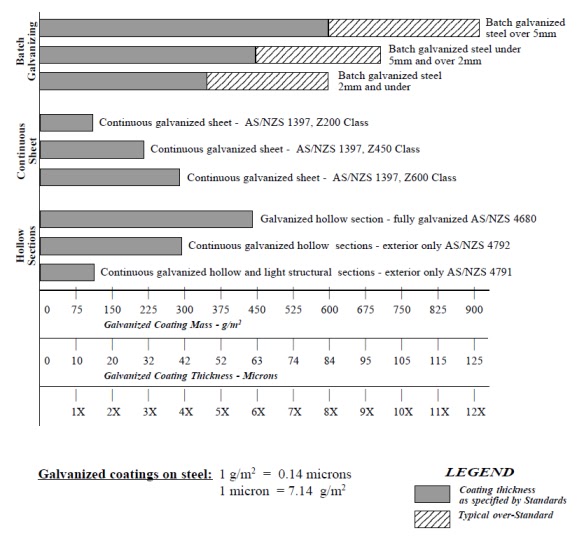
1. Coating thickness - BATCH galvanized items of the same section thickness are typically at least 3 TIMES thicker than similar CONTINUOUSLY galvanized coatings on sheet and tube.
2. Coating hardness - BATCH galvanized items have much thicker zinc/iron alloy layers in the coatings which gives BATCH galvanized items 5 TIMES the abrasion resistance of CONTINUOUSLY galvanized coatings.
3. Coating integrity - BATCH galvanized coatings apply a uniform heavy coating to all internal and external surfaces, edges and cavities. CONTINUOUSLY galvanized coating will always have exposed bare steel at cut edges. CONTINUOUSLY galvanized hollow sections are fully galvanized on the external surfaces only.
4. Coating mass - The cathodic protection of exposed steel by zinc depends of the mass of the zinc in relation to the area of exposed steel. Because of the drainage characteristics of BATCH galvanized coatings, the coating mass on BATCH galvanized products is significantly higher (typically 3-5 times) in proportion to thickness than CONTINUOUSLY galvanized coatings. Hot rolled medium structural sections commonly achieve coating mass levels exceeding 1000 g/m2.

MORE COATING THICKNESS = LONGER COATING LIFE
150 years of field testing has determined that all things being equal, galvanized coating life is equivalent to galvanized coating thickness. When comparing BATCH galvanized coatings to CONTINUOUSLY galvanized coating, all things are not equal.

THE CUT EDGE FACTOR
All CONTINUOUSLY galvanized sections have exposed steel at cut edges and rely on the adjacent zinc in the coating to provide cathodic protection to the bare steel. This requirement accelerates the rate of corrosion of the galvanized coating at cut edges. The thicker the CONTINUOUSLY galvanized section, the faster the rate of coating corrosion at cut edges because of the greater area of bare steel exposed. Even if it was possible to apply a CONTINUOUSLY galvanized coating to a steel item to the same thickness as a BATCH galvanized item, the cut edge factor gives the BATCH galvanized coating a life typically 1.5 TIMES greater.

COMPARISON OF GALVANIZED COATINGS
CONTINUOUSLY galvanized coatings comply very closely to their specified coating mass. BATCH
galvanized coatings on hot rolled steel sections almost always exceed their minimum specified coating
mass.


.